
 NEWS
NEWS
The Economic Forum began its work in Ashgabat as part of the SPECA Week
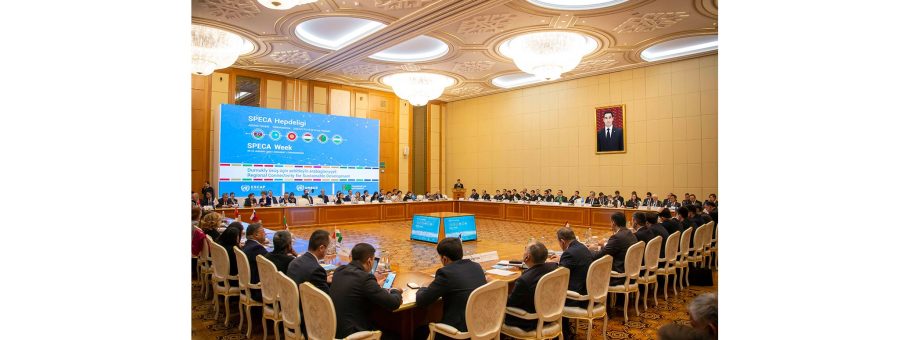
On January 21, 2026, the Economic Forum began its work in Ashgabat as part of the United Nations Special Program for the Economies of Central Asia (SPECA) Week.
The Forum brought together heads and representatives of relevant ministries and sectoral agencies of the Central Asian countries, Azerbaijan, India, as well as international organizations, including UN specialized agencies, the European Union, the World Bank, and others.
The objective of the Forum is to comprehensively consider opportunities for shaping a new architecture of economic cooperation across the Eurasian space.
During the opening ceremony of the Economic Forum held as part of SPECA Week, a congratulatory address from President Serdar Berdimuhamedov to the participants was read out. The message emphasized that the Economic Forum, taking place in the year marking the glorious 35th anniversary of the sacred independence of neutral Turkmenistan, would contribute to the successful implementation of the country’s consistent efforts, together with other SPECA member states, to achieve goals aimed at ensuring the further development of the region.
This was followed by the plenary session of the Forum.
Speakers at the session, held in a hybrid format, highlighted the strategic importance of Turkmenistan’s initiatives aimed at enhancing cooperation within the SPECA framework. It was noted that, in the current context, the Programme, by facilitating the transformation of the Central Asian region into one of the rapidly developing transport, logistics, and energy hubs on the Eurasian continent, serves as a key factor for sustainable development.
The significant role of Turkmenistan’s transport diplomacy was also underscored. According to the speakers, the formation of multimodal transport corridors and the simplification of transit operations meet not only the interests of the states of the region, but also those of the global community as a whole.
In presentations by representatives of the Turkmen side, it was emphasized that in the context of global geopolitical and geoeconomic transformations, strengthening regional connectivity is of particular importance, especially in such key areas as energy, transport, and trade.
At the same time, it was noted that Turkmenistan attaches great importance to trade and economic partnership with SPECA countries. A vivid confirmation of this is the growth in mutual trade turnover between Turkmenistan and SPECA member states in recent years.
Within the discussions, particular emphasis was placed on issues of digital transformation and innovative development. Participants highlighted the need to introduce modern UN standards into customs and trade procedures.
During the discussion on investment issues, speakers underscored the importance of establishing a multilateral partnership trust fund.
Attention was also focused on issues of environmental sustainability and the efficient use of natural resources. In this context, the necessity of ensuring the inclusive nature of economic growth was emphasized.
At the conclusion of the plenary session, foreign participants expressed their appreciation to the Turkmen side for the high organizational level of the Forum and the favorable conditions created for productive dialogue.
The Forum then continued its work with a thematic session entitled “Energy Connectivity in the Trans-Caspian Region and Beyond,” during which attention was given to the role of Central Asia as an important link in ensuring global energy security.
Within the thematic session “Transport Interconnection for Improving the Efficiency of Eurasian Transport Connectivity,” participants focused on the need to promote the development of multimodal transport corridors. According to the participants, integrating national transport networks into a unified SPECA system would significantly increase the volume of transit cargo flows.
The Forum then proceeded with the thematic session “Strategic Vision for Sustainable Development,” which discussed integrated approaches to the implementation of the 2030 Agenda for Sustainable Development.
On 22 January, the Forum continues its work in the format of thematic sessions.